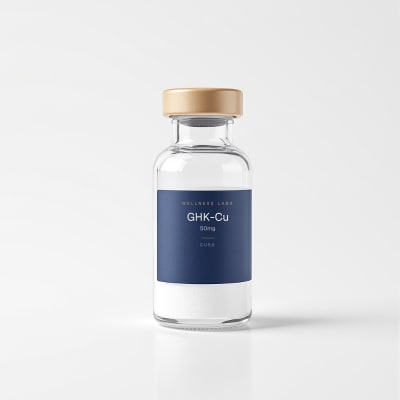
GHK-Cu 50 mg
GHK-Cu is a naturally-occurring tripeptide (glycyl-L-histidyl-L-lysine) bound to copper, found in human plasma at progressively lower concentrations with age. It is the most-studied copper peptide in the cosmetic and connective-tissue research literature, with applications spanning collagen-signalling research, skin-research protocols, and broader connective-tissue remodelling studies.
What GHK-Cu is
GHK-Cu is the copper-bound form of the glycyl-histidyl-lysine tripeptide. The peptide alone is biologically active in some respects, but the copper-binding step is what gives GHK-Cu its full research-relevant profile — copper acts as the catalytic cofactor for several of the downstream enzymes the peptide-cofactor complex influences (notably lysyl oxidase in collagen cross-linking). The native human form circulates in plasma at approximately 200 ng/mL in early adulthood and declines steadily with age.
What the research literature covers
Published research on GHK-Cu spans cosmetic skin-research (topical applications to dermal collagen and elastin remodelling), wound-research models (rodent and small mammal dermal closure rates), hair-follicle research (effects on dermal papilla cells in vitro), and broader connective-tissue questions. GHK-Cu is one of the few research peptides that has substantial human cosmetic-research literature alongside the more typical animal preclinical data — it has been used in clinical-grade cosmetic formulations for decades.
GHK-Cu vs the wider catalogue
Most peptides in the research catalogue target internal pathways — gut, thymic, mitochondrial, hypothalamic. GHK-Cu is the catalogue's skin-and-connective-tissue compound, which makes it the natural pairing for any tissue-recovery research that includes a dermal or surface component. Researchers studying scar-research protocols, post-laser dermal recovery, or hair-follicle research frequently include GHK-Cu alongside other recovery compounds.
Quality verification
Two-stage Wellness Labs verification: upstream ICH Q7 GMP manufacturing, independent HPLC analysis at a third-party US laboratory. Acceptance criterion: ≥98% peak-area purity at λ=214 nm against USP-NF, Ph. Eur., or JP reference standards. Each released batch ships with a Certificate of Analysis covering both the peptide sequence and the copper-binding ratio (Cu:peptide stoichiometry is QC'd separately).
In the ghk-cu range
Common questions
- Is GHK-Cu legal in the UAE?
- GHK-Cu is sold openly in the UAE both as a cosmetic ingredient and as a research compound. It is in the formulation of many UAE-pharmacy cosmetic products. Wellness Labs supplies research-grade GHK-Cu under standard UAE commercial trading rules with VAT compliance applied to every dispatch.
- How is GHK-Cu typically used in research protocols?
- Two main approaches appear in the literature: topical (compounded into a research vehicle for dermal application — the most common cosmetic-research route) and subcutaneous administration (used in research protocols studying systemic connective-tissue effects). Topical doses vary by formulation — typical cosmetic research uses 1-3% concentration. Systemic protocols in the grey-research community report 1-2 mg per administration, 2-3 times weekly.
- How is GHK-Cu different from regular GHK?
- The peptide alone (GHK) has activity but the copper-bound complex (GHK-Cu) is the form with the full pharmacological profile cited in the research literature. Copper acts as the catalytic cofactor for lysyl oxidase, the enzyme responsible for collagen cross-linking. Researchers who buy "GHK" without explicit copper binding may not be getting the form actually studied in published research.
- Can I use GHK-Cu alongside BPC-157 or TB-500?
- Yes — they act through different pathways. BPC-157 and TB-500 target internal tissue-recovery mechanisms; GHK-Cu targets skin and connective-tissue signalling. No interaction has been reported in published research between these compounds. Researchers studying composite-recovery questions (where dermal or scar components are part of the picture) frequently include GHK-Cu.
- What is the colour of authentic GHK-Cu?
- GHK-Cu is distinctly blue in solution — that is the copper. Reconstituted into clear water, you should see a noticeable blue tint. Vendors selling "GHK-Cu" that reconstitutes clear are selling GHK without confirmed copper binding. This is one of the visual quality checks researchers run on copper-peptide deliveries.
- What is the shelf life and storage protocol?
- Lyophilised GHK-Cu is ambient-temperature stable in transit. Long-term storage of unreconstituted vials is recommended at -20 °C protected from light. After reconstitution, refrigerated storage is required; specific stability data accompanies each batch.
- How fast is delivery in the UAE?
- Same-day in Dubai, next-business-day across the UAE. GCC delivery in 3-5 business days.
- Can Nour help me design a topical-research vehicle?
- Nour can walk through the published GHK-Cu cosmetic-research literature and the typical research-vehicle formulations (carrier creams, dermal-research bases). Final formulation decisions sit with the researcher; Nour provides the literature context, not formulation IP.
Related categories
Not sure which is right for you?
Nour reads peer-reviewed studies and walks you through what each compound is best suited for. English or Arabic, inside the chat.